Tuesday, June 12, 2012

Chelsea FC

Tuesday, 12 June 2012


A visit to Stamford Bridge, home of the reigning European Club Champion Chelsea FC, is a bit like visiting Wrigly Field or Fenway Park in the States. Opened in 1877, "the Bridge" has the same authentic feel and eccentricities of a place that is as much Museum as Stadium.

Located in the burroughs of Chelsea and Kennsington, part of the 32 burroughs that make up London, Stamford Bridge is the closest Premier League stadium to the heart of London at about 20 minutes. At a capacity of 42,000 people, the venue is intimate, yet the 7th largest English Premier League venue. It reminds me of running at Hayward Field in Eugene, OR - the best Track and Field venue in the USA though far from the largest.

The reach and fan base of the club is so great Samsung pays 80 million Pounds to put their logo on the front of the teams Jersey. Adidas pays 100 million pounds to provide jerseys to the team and the millions of fans who shell out big bucks every year for a replica. The two story gift shop is bigger than the museum that tells the 107 year history of the Club if that gives you any indication.

We sat for a photo at the interview table in the pressroom we see so often on the Fox Soccer Channel. From this spot, live shots of coaches and players doing interviews are beamed around the world. Our tour group includes people from India, Dubai, Egypt, Denmark, San Francisco (and Colorado), as well as from around the UK. The English Premier League and Chelsea FC truly draw a global fan base. The Egyptians ask questions about who will replace their Stryker, Didier Drogba from France, who won't return after seven years with the Club. Regardless of where they reside, these fans of the club in Blue know their team.

The "Losers" dressing room, as they call it, is tiny compared to the home teams dressing room, even after being recently remodeled and enlarged. The new mirror in the visitors dressing room was put in "specifically for Cristiano Ronaldo to admire himself" quips the Chelsea staffer leading our tour.

The players, of course, are all back with their National teams, most  playing in the European Championships being contested in Poland and the Ukraine right now.  Even so, the joy of Chelsea winning their first European Champions League title and the FA Cup this year is quite fresh on everyone at Stamford Bridge. The Cup is in the museum and for 30 pounds you can get three picutre of yourself with it. The Clubs name and year of victory is engraved on the trophy and, like the Stanley Cup in Hockey, travels year-after-year with the reigning champion. Faster than you can say "tourist," we shell out 30 Quid and get the shots along with making a donation on gift shop souveniers.

Joelle is beside herself when we see a mural of Petr Cech, the Chelsea Keeper she likes to mimic when playing between the pipes herself. Better known for the padded helment he wears than saving more shootout PKs than his Bayern Munich opposite to decide the Champions League Champion, Cech is nothing short of a colorful character.

Given a choice we would spend the day with the club from Barcelona but when in London, hanging out with the boys in Blue at Stamford Bridge is a great call. It is awesome to get to know a classic Premier League team up close. It doesn't quench our thrist however. In fact, it makes it worse as now we want to come back for a match!


Monday, June 11, 2012

A Day with Harry Potter

Monday, 11 June 2012

Enough with the history of Kings, their palaces, wives, and conquests, today is about Harry Potter, a subject far more fascinating with intimate details at the Girl's immediate recall. Today, VII and VIII denote not a Monarch but the last installments of Harry Potter.

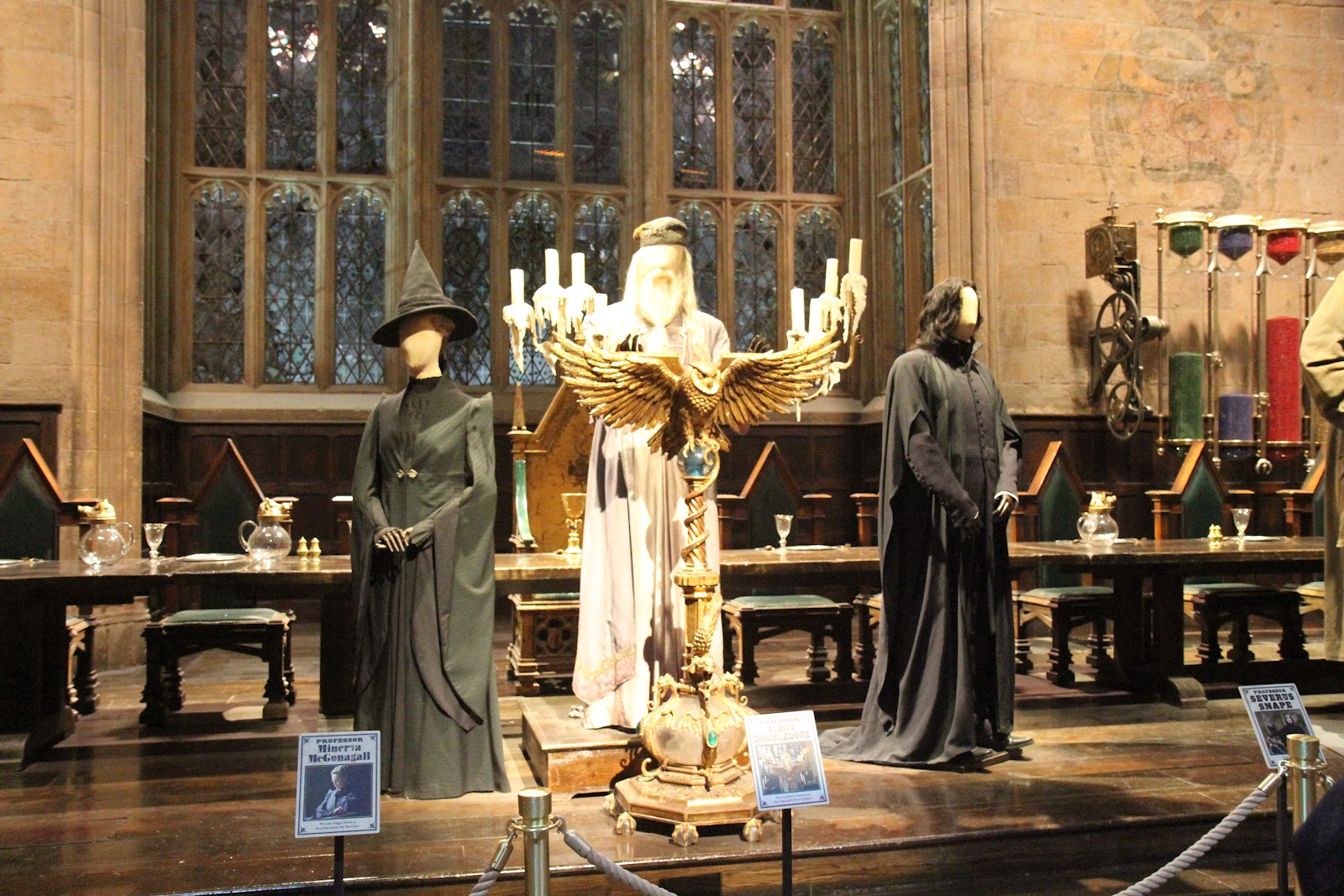
"Welcome to Hogwarts" we are greeted as the doors to the Great Hall swing open.

"Harry had never even imagined such a strange and splendid place. It was lit by thousands and thousands of candles that were floating in midair over four long tables, where the rest of the students were sitting. These tables were laid with glittering golden plates and goblets. At the top of the hall was another long table where the teachers were sitting...Harry looked upward and saw a velvety black ceiling dotted with stars. He heard Hermione whisper, "It's bewitched to look like the sky outside. I read about it in Hogwarts a History"

Our first view of the Great Hall could be described the same way Harry saw it, expect our ceiling is dotted with spot lights and LEDs pefectly illuminting the Hall in all the right spots. The Hall is a "warm set" in that it is ready for shooting. The lecturn in the center appearas ready for Dumbledore to step forward and address us all.

The set is in one of two giant Warner Brothers sound stage buildings in Leavesdale one hour northwest of London that has been masterfully converted into "The Making of Harry Potter" experience. For 10 years 2,000 cast and crew worked here to make the eight films. The artifacts of their work are exceptional. Three hours seems a fraction of the time required to see even half of it properly.

The Gryfendor common room and sleeping chambers look as though you could move right in. Awe struck and giddy, the girls would do exactly that.. Dumbeldore's office, Umbridge's office at the Ministry of Magic, the Ministry lobby and Flues, Professor Slughorn's potions classroom, Luna's wardrobe, the five inanimate Horcruxes, Weasley's Dining Room and Flying Car, and that is just the first sound stage building.

After taking a CGI broomstick flight through London, we grab a Butter Beer and head to the backlot between the buildings. The Knight Bus, Haggrid's motorcyle and sidecar, and one of 17.5 flying light blue Ford Anglias used in the movies immediately grab your attention. Behind them sits the only address in England perhaps more famous than No. 10 Downing Street - No. 4 Privet Drive. The Potter's vacant Godric Hollow home sits next door and infront of the bridge connecting Hogwarts to the Dark Forest.

The Knight Bus is especially interesting. Designers put four tons of additional weight in the bottom of the top heavy, three story, bus to keep it from tipping over. The beds and chandelier are all inside. To bad Ernie isn't present to tell a few stories.


This morning before riding out to Warner Brothers studios, we visited Lambeth Bridge where Ernie pulls the lever to compress the Knight Bus and squeeze between two oncoming buses. "Hey fellas, why the long faces," quips the Shrunken Head. Big Ben and Parliament are both in the shot and so they are as we approach Lambeth Bridge. Harry Potter sites in London, it is more excitment than the girls can handle without fits of giddy laughter.

We are greeted in the back of the second sound stage by Goblins, Elves, Spiders, a Norweigan Ridgeback Dragon, a Thestral, and a cast of other occupying the Creatures workshop.

"Harry wished he had eight more eyes... There were shops selling robes, shops selling telescopes and strange silver instruments Harry had never seen before, windows stacked with barrels of bat spleens and eels' eyes, tottering piles of spell books, quills, and rolls of parchment, potion bottles, globes of the moon...." reads the description of Harry's first trip to Diagon Alley. As we pass Gringots and turn up Diagon Alley for ourselves, we feel the same way. The wave of awe that comes over the girls face is exactly what you would expect having read all the books three or more times a piece and nearly worn out the DVDs.

Like the Great Hall, Diagon Alley is a warm set, dressed as it was in the final movie. Olivanders is burned out. The Weasley Brothers bright red shop and huge W domiating the Alley. On our morning site visits in London, we stopped at Leadenhall Market in the Financial District which served as the original "on location" set for Diagon Alley. The girls took pictures in the doorway that served as the original entrance to the Leaky Cauldron. The Australian Embassy in London served as the interior of Gringots Bank and is strictly off limits unless you are on offical business.

The indoor stage built for the final movies looks quite different other than the cobbles, which is exactly how it unfolded, with storefronts changing throughout the series. Both sets successfully transport the imagiation to another place.

Next, we pass through two rooms full of drawings and artists concepts for various sets and buildings prior to their actual construction. The designs are literally architechtural renderings, schematics, which make you realize all the more the tremendous detail and planning that went into bringing these places to life. Buildings like the Three Broomstricks, the villages of Hogsmeade, and Godric Hollow, pieces like Dumbledore's lecturn, Hagrid's Hut, all of precisce drawings depicting them from concept through schematic.

Exiting the concept rooms, we round a corner and there it stands, the Hogwarts School for Witchcraft and Wizardy, the most complex and dramatic building of them all. It took 400 people 7 months to construct the model. So big, it occupies the entire width and hight of a room all its own. Every detail is precisely painted. The interior is lit by 3,000 fiber optic lights precisely placed in rooms, corridors, and stairwells to make the grounds come alive. The model was used in the first six movies for outdoor and panaramic shots. The technology to digitally produce Hogwarts did not exist prior to the 7th movie.

"Hogwarts, it does exist," says Tom Felton (Draco Malfoy) the voice on our audio guide through the exhibit. We couldn't agree more!


Exiting through the gift shop as every good capitalistic venture of this nature does, we can't help but to purchase a Marauder's Map, that always come in handy. The Chocolate Frogs are also to much to pass up; although, the girls are less than impressed that the Wizard card in our box is that of Salazar Slytherin.

Take a poll of the four McDonalds on this tour of Eurpoe and the vote is easily 3 "for" with myself obstaining from the vote for purposes of self-preservation that the Harry Potter attraction is the best and most significant thing we have seen in Europe. Hogwarts, I must confess, is one of the few places to make Versailles and Hampton Court Palace look ordinary.


Sunday, June 10, 2012

Henry VIII and Hampton Court Palace

Sunday, 10 June 2012


“I call to order on this day in April 1532, the King’s Privy Council,” declares George Boleyn, “to discuss the bill we will submit to Parliament next week.”
King Henry VIII shares his itnent to annul his marriage
to Katherine of Aragon and marry Anne Boleyn

Attending the Privy Council in the role of a Bishop and adviser to King Henry VIII, I sat at the King’s right hand side, albeit my chair 2 feet lower than his, from where he presides over the 10 members of his Privy Council. 

The audience participation re-enactment is quite convincing and the position of the large King both convincing and intimidating. When he asks "Do you not agree..." it doesn't exactly come as a question.

"Katherine of Aragon (the King’s wife of 20 years and Daughter of King Ferdinand II and Queen Isabella of Spain) “does not want our marriage annulled," the King address to myself and other members of the Council. "Yet I know it to be illegitimate in the eyes of God. It says in the Book of Leviticus 'If a brother is to marry the wife of a brother they will remain childless.' Though my brother Arthur died before I took her as my own, I know God is punishing me by not delivering a male heir to the throne of England."
Hampton Court Palace - the Tudor Styled Entrance


The bill in question will divorce England from Rome by removing the Church of England from the Pope’s authority and recognizing Henry VIII as the leader of both Church and State.

"Gentlemen, the Pope and I are aligned on matters of the Bible. This is a matter of politics,” the King’s voice booms through the Council chamber. “My wife’s nephew, “ Charles V, the ruler of the Roman Empire and influential with the Pope in Rome, “presses the Pope that the marriage should not be annulled for his own political gain. This is a matter of politics Gentlemen. Do you want to be without an heir to the throne of England? To be ruled from Rome by a Bishop? To risk returning England to Civil War again? That is what will happen I assure you.”
Seated at the King's Table

Despite their 20 year marriage and very successful allegiance and teamwork, the King has no heir and Katherine has moved beyond prime child bearing age. Never mind she fought off an invading army of Scotts while Henry VIII was fighting in France. The only thing that matters is one simple fact - the King has no heir. The rest is political maneuvering to solve that problem.  Dividing sentiment in England, divorcing with the Pope and Catholic Church, leaving his wife, it is all a high stakes political game to keep the Tudor family attached to the throne and win greater influence over all of Europe.

“Gentleman I propose three things to you three things" and proceeds to tell his Council to what they are to agree:

Where the Tudor and Baroque styles adjoin
 First, that the Council (and later Parliament) pass a bill renouncing the Pope and uniting Church and State in England under the King

Second, Thomas Cranmer be appointed to the post Archbishop of Canterbury to lead the Church (and legally annul his first marriage).

Third, to bestow sufficient title upon Anne Boelyn for them to marry after everything is done properly such that the son he hopes to have with her will be the legitimate heir to the throne of England.

Ironically, it would be his youngest daughter, Elizabeth I from his marriage with Anne Boleyn, that would rule the longest of his children, 45 years, even though he would later have Anne beheaded on Tower Hill and go through four more wives seeking a strong male heir.

And so it was at Hampton Court in 1532.

Nearly 400 year old Maze in the Palace Gardens
Hannah and Joelle soak up the dramatic re-enactment and the opportunity to participate. Nothing like taking part in history to absorb the context of it all. King Henry VIII's assembly line like kitchens to feed 6,000 people, the living chambers, Privy Council Room, Dining Hall, Bed Chambers, Court Yards, and Gardens all spring to life when the characters that occupy them are returned in period dress.

Dating from the early 1500s, Henry VIII began enlarging the palace in 1524 after effectively taking it from his former Finance Minister and closest adviser. Sounds a lot like the story of Louis XIV in France over 150 years later.

Notably, Louis XIV had tremendous influence over Hampton Court Palace. William III after seeing Versailles endeavored to add onto and begin renovating Hampton Court Place in a Baroque style. Running out of money before completing the project resulted in a palace today that is effectively two adjoined, one in the original Tudor style dating to the early 1500s and the later Baroque style influenced by Louis XIV.

The palace has not been occupied by the Royal Family since the 18th Century, but it is still impressive to behold, an important historical treasure of the Royal Family, and a clear stepping stone in the history of England to the palaces and leaders that were to follow.

Tudor Courtyard within the Palace
Clock Tower - Astrological Clock that also keeps
the Tides, and phases of Sun and Moon


Welcome to London

Saturday, 9 June 2012


“Worst Storms for a Decade” scream the headline of the Daily Express.

“Depressed? You will be as series of lows brings cold, rain, and gales” another paper shouts.

Welcome to London.

Two and a half days until Weathergedon arrives and thoughts of catching a flight to Spain are seriously considered. A couple just arrived from Scotland describe the weather as “freezing cold…shivered for days” furthering thoughts of destinations bordering the Mediterranean until we learn they are from Florida and discount entirely their assessment of what constitutes cold weather.

Nevertheless, it sets Laura on a mission – see as much as possible as fast as possible – and everyone knows what happens when she sets her mind.

From our first stop at Leicester Square, we walk through Trafalgar Square, visit Benjamin Franklin’s Craven Street home of 16 years, view Big Ben, Parliament, the London Eye, and Whitehall from Hungerford Bridge over the Thames at Embankment Station.

A quick Underground hop to Tower Hill, and a check goes next to the Tower of London, Crown Jewels, Tower Bridge, the Gherkin, and the nearly complete Shard at London Bridge. Dinner in Camden Town and a bus ride back to Regent’s Park and our loop is complete.

We experienced Bangers and Mash, Fish and Chips, Fish Pie, and a Boddingtons on tap last night, so if London ends tomorrow, we have at least covered the basics.

The juxtaposition of old London icons and more recent additions to the skyline like The Shard and Gherkin make London all the more fascinating.

More to come on the Tower of London, always one of my favorite stops in London, and a surprisingly great visit to Ben Franklin's house.

A bit of trivia ahead of that post:

Who was the most famous prisoner of the Tower of London? An English Aristocrat, imprisoned there twice, once by a Queen who herself was imprisoned there before becoming Queen, he twice sailed to South America in search of El Dorado "The City of Gold" and was executed in 1618 having again fallen from favor with the English Monarchy.

The Gherkin (2004) behind the Tower of London (founded 1066)
The Shard (2012) behind Tower Bridge (1894)

Friday, June 8, 2012

Au revior au Paris

Friday, 8 June 2012

Pulling out of Gare du Nord aboard Eurostar bound for London by way of the Chunnel this afternoon, we couldn't help but talk about some of our favorite moments from our time in Paris and excursions to Normandy (and Bayeux) as well as Versailles.

We collected some amazing photos, many of which we couldn't share as I haven't been able to pull them off Laura's camera. First priority when arriving in London today was to find a memory card reader. That was a task I wasn't up for figuring out in French!

With a bevy of new photos available, we updated the blog on Notre Dame and Bayeaux with a few of our favorite photos.

I also you thought might appreciate a few shots on one of our favorite topics of the trip - Gastronomy!

The only menu Hannah needs in Paris


How do the French stay so skinny?
Just say "yes"

Panini!


Mussles at Monemartre


Crepes at the Eiffel Tower
Seven layer Crepe in Bayeux


Nos Specialities - Entrecôte

Tarte aux Fraises

Bike About Versailles

Thursday, 7 June 2012

Louis XIV and his curls
When you’re the King of France at age 5, the line between God ordained monarch and regular guy isn’t blurry at all – you’re ordained by God.  Effectively you were born a King. There was never a doubt. You have known nothing else.

So when the Noble with the grandest estate in France, Nicolas Fouquet, throws a party for 6,000 people in your honor to celebrate your coming of age and assuming your born right as King, isn’t it a perfectly natural reaction to accuse your host of embezzlement, lock him in prison, and hire his painters, gardeners, architects, and anything else you need to build your own 700 room “Chateau”?

While you’re at it, install a Grand Canal in the shape of a cross large enough to reenact battles upon or have Venetians conduct you in a Gondolier. You will need to reroute the Siene, but that's a detail. Since government offices are inconveniently located 20 minutes away, at your current residence, Le Louvre in Central Paris, you will want to build new government buildings, a chapel, and basically a whole new town while you're at it.

Backroads of Versailles
And so he did. Over a 50 year period that saw him employ 40,000 people, Louis XIV guided the creation of an Estate so grand you’re best to rent a bicycle for the day to tour the grounds.
Looking down the "small" canal to the
intersection with the Grand Canal
And so we did. On four bicycles from Bike About Tours, with Amber, our Dutch/French/Anglo always animated guide, we pedal our way around the Estate.  The back gate doesn’t see the traffic of the front so few see the working dairy farms or portions of the grounds that remain closer to their hunting origins. It is bizarre to come through a section of woods and into a clearing with rows of perfectly coiffured trees along a man-made Canal intersecting another Grand Canal.

The grounds are natural enough that when the clouds open up there is nowhere to go and you get soaked. Ducking under umbrellas near Petit Trianon, a smaller palace built away from the Chateau to which the King could retreat from the stresses of court life. Louis XVI gave it to Marie Antoinette when they married. She added an Hameau, a “tiny” country village and farms to make you feel truly away from it all. Don’t worry; the staff will milk the cows for you. 

Part of Marie Antoinette's Hameau
From the perspective of common folk whose taxes funded the extravagance at Versailles, it isn’t hard to see how the French monarchy effectively came to an end when Louis XVI met the guillotine at Concorde adjacent Le Louvre. Louis XIV moved the government there in 1682 and Louis XVI moved it back to Paris in 1789 after the French Revolution began. A poster child for absolute monarchy, it certainly wasn’t an era of government “by the people and for the people.” Nevertheless, what Louis XIV created and Louis XV and XVI furthered is truly remarkable. The focus and spending on the arts fueled the Renaissance era and in so many ways came to define a culture and a nation.

Front of the Chateau with Louie's Bed Chamber in the Center
Watching the kids navigate the rutted out back roads of Versailles on bikes is a blast. It was like going back stage before the show. As we cross the cobbles through the main gate, we get the jaw dropping wow Louis XIV was after. The gates, roof lines, and ornate trim of the Chateau, Chapel, and adjoining administrative wings burst forth in fresh gold paint, bring the renaissance architecture alive with the grandeur you would expect.

Hall of Mirrors
Our first tour stop is the Chapel Louis XIV visited every day for Mass, especially later in his life. Passing through room after massive room covered in spectacular paintings, sculptor, painted ceilings, dramatic windows and fire places, they all begin to look the same. That’s when it hits you – there is no furniture anywhere. It’s like walking through a house on the market for too long. There is nothing to make the throne room look like the throne room. You can’t picture how anyone lived here.

Grand Canal View from the Hall of Mirrors
The French were so mad at Louis XVI and Marie Antoinette that in destroying the people they hated their rage took much of their precious cultural history and valuables as casualties. Today the French are still trying to find and buy back the furniture and other property that wasn’t burned or otherwise destroyed. The elaborate wardrobe of the young Austrian Princess, Marie Antoinette, who came to France at age 14 to be Louis XVI’s Queen, was scattered or burned. Much of the furniture is in England having been eagerly acquired at auction for a pittance.

You know instantly when you enter the most famous room in the Chateau. Seventeen mirrors, one opposite each second floor window looking down the Grand Canal, mark your entry to the Hall of Mirrors. It doesn’t need furniture to be mesmerizing.  Louis XIV sitting on the opposite end awaiting foreign dignitaries, Louis XVI receiving Benjamin Franklin, world leaders arriving to sign the Treaty of Versailles and end World War I, you can picture it all. Allegedly it was here Louis XIV, while dressed as one of five trees at a masquerade party, met his longtime mistress Louise de La Vallière.

The King's Bedroom and center of the Chateau
Off the Hall of Mirrors, overlooking the courtyard on the front side is a waiting room to the King’s bedroom containing one of two pieces of furniture in the whole place - the King’s bed. The bed is placed at the exact center of the Chateau (he was the Sun King after all). A meeting room and dining room are beyond the bedroom before you are looped back to the Hall of Mirrors. Exiting the Hall takes you through the Queen’s chambers and the Queen’s bed, the only other piece of furniture in the place. Wide open in the corner of her bedroom is the secret door through which Marie Antoinette temporarily escaped the night Versailles was stormed by Revolutionaries.

Five things jumped out at me while touring Versailles:

Queen's Bedroom
First is the sheer size and scale of the grounds. I expected opulence and I knew it was big, but until you ride your bike around the massive grounds that surround the Chateau it isn’t possible to truly understand.

Second, Versailles is also a town complete with hotels, markets, homes, citizens, and a train station, none of which was here when Louis XIV decided to move Court from Le Louvre to Versailles.

Third, as much as Louis XIV lived his life in public and designed his Chateau – the bedroom, dining room, etc. – to be seen, he truly enjoyed getting away from the public eye. He was a hunter and an outdoors man. Moving from Central Paris was not just to build a grand estate, but also his way of getting out of the City to a place he was more comfortable and wanted to live.
Fourth, there are no kitchens anywhere in palaces. Cooking with fires had a nasty way of burning down your palace when something went wrong so kitchens are separated. “Warming Huts” are constructed nearby to warm the food back up before it is served in order to avoid the risk - no venison steaks served hot off the grille at Versailles.

Fifth, the transition from rule by Monarch to rule to a Republic didn’t go very well. Unlike England, the Monarchy was done away with entirely. The gap between Louis XVI and Napoleon, saw the reign of Terror when 30,000 people were executed in one year alone at the hands of revolutionaries who knew how to hate the Monarchy but not how to lead a country. Ultimately it was the military and Napoleon who returned France to prominence.

Our favorite thing about the day was the bike ride. Blasting through the palace grounds and the streets of Versailles was a cool twist when you aren't big museum goers in the first place. Laura’s Achilles liked the bike a lot more than walking. Hopefully we can weave more biking into our transit plan.

Bike About Versailles

Wednesday, June 6, 2012

Central Paris

Wednesday, 6 June 2012

A panel on Le Arc de Triumph
that made Joelle's "Naked Count"
The naked body count hit 73 today. We learned Joelle has been tabulating since we landed, mostly male genitalia. We haven't been to the Moulin Rouge or included the sculptures at the Louvre. Metro stations are lined with billboards promoting the London Olympics featuring fat, and I mean fat, naked statues engaged in something that may not actually be an Olympic event. We hope it is a joke with one heck of a punch line.

Ecole Militarie is our first gopher hole of the day and a short walk to the Eiffel Tower. There are between 667 and 690 steps from the ground to the second level deck depending on if you go with Hannah or Joelle's count. That half the elevators are closed until August for undisclosed technical issues and repairs doesn't fill you with confidence. Factor in the length of the resulting line to ascend in the operable elevator and climbing the stairs switches from a romantic ideal to a no brainer. I won't bother to comment on the number of people stopped at various points along the stairs, other than to say a significant number were covered in various NY Yankees memorabilia.


The Eiffel Tower view is the best in Paris for understanding the relative location of the major land marks. Sacre Couer at Montmartre is the second highest point in Paris, as spectacular from the Eiffel Tower as up close. Notre Dame is dwarfed by the city surrounding it but immediately recognizable. Napoleon's resting place under the center of Le Dome is easy to pick out covered in gold. Follow the Siene past Le Louvre, the Obolisque, Concorde, up toward the Le Arc de Triumphe, over the Siene to Bois de Bologne, the Central Park like woods I have been running in near the hotel. On the horizon line is Chateau St Germaine where we stood with Didier on Saturday and admired the Eiffel Tower 15km away.

Laura's bum wheel is getting worse. The Achilles she hurt May 19th, when a 12 mile run became 17 miles after a wrong turn, is getting worse with at least 5 miles of walking each day. She skipped the Eiffel stair climb all too happy to hang out with her Kindle. We pick her up and decide to board a river cruise across the street - great views from the river, no walking required.

Notre Dame from the Siene River
We pass Musee D'Orsay which Le Louvre moved several exhibits into, including a Degas collection, as they were running out of space. Notre Dame from the river presents a dramatic new perspective. The granduer of the structure, through dwarfed by places like the Eiffel Tower, is timeless. It takes your breath away every time you see it.

Plaza of Le Louvre
We pass St Germaine, Hotel De Ville, and loop back down to Le Louvre, our stop. The view from the Siene is not to be missed. The sense you get for the old walled City and the defensive purposes it served is dramatic to see and fun to think about from a tactical perspective. Many invaders must have scratched their head considering the right battle plan.

Le Louvre was originally a medieval defensive structure built to protect Paris as it expanded off the island. Eventually it grew outside those massive grounds and was no longer needed for defensive purposes. Over 500 years various Kings gradually tore down or remodeled much of the site in classic French Renaissance tradition. Massive and beautiful, it served as the palace for Louis XIV (and many predecessors) until he moved to Versailles upon its completion. The glass entry pyramid completed in 1989 actually makes sense to me having now seen it in person. Located in the courtyard between the various wings on the Louvre, the pyramid provides an entry way from underneath.

As the Washington Monument serves as a hub connecting the sites lines of the White House and TJ Memorial on one axis and the Capital and Lincoln Memorial on the other, so the Oblisque connects Le Louvre with the Le Arc de Trimphe (and the other two arches on the same sight line) and the Madeline (and if you allow some leniency, the Opera House) with two different ornate Assembly and Ministry buildings and the Invalides beyond that.

On a recommendation from Didier, we take lunch at Cafe de Marly at the Louvre overlooking the courtyard and entry way. Not sure how any of us ate with our mouths hanging open in admiration. We walk through the Palais Royal and its Gardens and make our way past the Opera House to Place Vendome, the high rent district. The high end Hotels, Retailers, and Jewelers all set up shop here reminiscent of Madison Avenue in New York City from the corner of Central Park past 57th Street and down to about 52nd. Tiffany, Cartier, Baccarat, Mont Blanc, Cheval, Rolex, etc - they are all here.

We dive into the gopher hole at Concorde and take the Metro out to Le Arc de Triumph and have a look back at the venues we spent our day walking (and floating) through in Central Paris. We decided to spend no time in Le Louvre today as the many unbelievable works of art to take in on the outside made it really hard to go indoors.

Anything with "Triumph" in the name will get my attention. Up close the Arc is indeed grand, triumphant, and many other words but doesn't really rank with the Central Paris tour. It makes sense that it is away from everything else.

Laura's Achilles is done so we make for Bolougne - Billancourt and drop the camera and heavy pack I have been lugging around all day. None of the pick pockets came after that pack.

To my delight Foursquare locates a series of restaurant and Chocolate Shop options near the hotel. I select Brasserie La Verrière for three reasons - it is close at .3 miles, it has the most check-ins in the area, and favorable reviews from those check ins.

I love it when the crapola I get for using 4SQ pays off. "Great choice Dad," Joelle confesses as we finish dinner. The best hot chocolate of the trip and a chocolate crepe on the way for dessert may have swayed her a tad, but I'll take it. "Scrumptious" comes up again to describe the hot chocolate. This must be what filled the Chocolate River in Willy Wonka's Chocolate Factory.

Over dinner we make our list of top likes and dislikes in Paris, not places, per say, but what we have experienced.

Dislikes:
1. Smoking - you literally can't go anywhere without the overwhelming smell of second hand smoke
2. Pushy Scammers - you learn quick not to stop or even look at the myriad of people who know you aren't local and want to hustle you - sketch artists to Eiffel Tower salesman, petitioners to pan handlers, it is over the top and you can't be afraid to push back.
3. Our (lack of) French - we have done well for two year olds, but it gets frustrating and exhausting being a well educated stupid person
4. Laura's Achilles - she is in constant pain at this point and moving at half-speed for at least five miles each day.

Likes:
Jo working the Hot Chocolat
1. Pleasant Locals - the French get a bad rap, especially in Paris for being rude to people who don't speak the language. Granted we are making an effort, but people have been incredibly pleasant and far more helpful than somebody in NYC would be to a non-English speaking French National visiting New York.
2. Metro Passes - the unlimited use of the Metros on one 5 day pass is simply awesome and super convenient and well worth the pick pocket risk provided you stay alert. I wish Joelle would have worn her red belt.
3. Hot Chocolate - think Willy Wonka's Chocolate River
4. Panini - the girls absolutely love the ham and cheese panini from the Pasterie near our hotel

Piggy Back Ride for the Bum Wheel
We raise a glass at dinner in honor of our 20th Anniversary but truthfully everyone would vote to skip straight to dessert and bed at this point in the day. Laura gets a piggy back ride the .3 miles back to the hotel. The girls didn't think I could do it so I did...yep, I'm still me even in Paris.

Au revoir!