Saturday, June 23, 2012

Glenfinnan Viaduct

Thursday, 21 June 2012

How does one of the most distinguished landmarks in Scotland lose its name? A landmark so famous it appears on the Bank of Scotland’s 10 Pound note?

Put it in Harry Potter.
Catching a glimpse of the Harry Potter Bridge

The girl’s faces are crammed against the glass of the Jacobite Express as we approach Glenfinnan. They aren’t alone. All the passengers are pressed against the glass hoping to catch a glimpse of the “Harry Potter Bridge.”

Dobbie the Elf sealed the doorway to platform 9 ¾ at King’s Cross hoping to keep Harry from returning to Hogwarts for his second year believing it to be too dangerous. Harry and Ron “borrow” the Weasley family car, a light blue Ford Anglia 105E modified by Ron’s father to also be invisible. The pair achieve lift off and speed past Big Ben and head north out of London to catch the train.

Glenfinnan Viaduct from the Jacobite Express
The temperamental car nearly gets squashed by the train and Harry almost falls out high above Glenfinnan Viaduct. The scene makes great use of the tall arches of the bridge to create a dramatic fairy tale back drop suitable for the Hogwarts Express and forever changing the name by which the viaduct is known.

Having already seen the Ford Anglia at Warner Brother's Studios outside London, King's Cross and the St Pancras Hotel (where they lift off), and Big Ben, we, of course, had to come find the Harry Potter Bridge.

The Jacobite Express goes past the western most station in Scotland and turns north to the fishing village of Mallaig. The ride is two hours out and two hours back with a fantastic dinner stop at the Fish Market overlooking the Bay. The quality and freshness of the product brought to the pier is evident at dinner, but also watching a crew just returned unload their catch onto the pier.

Our only disappointment with the experience is no Thestrals awaiting our arrival to pull us in a carriage off to Hogwarts School for Witchcraft and Wizardry.

Fresh caught Prawns at Mallaig

The Highlands

Wednesday, 20 June 2012

The descent into Pitlochry is a drive straight into a post card yet a mere hors d'oeuvre for what is to come in the Highlands. Overdue with an update to the blog, I blame the Highlands. There simply aren’t enough hours in the day, let alone the five days we booked, to get enough of a land that has everything I could ever want (with the exception of world class powder skiing).

Western view of Loch Ness
from the top of Grant's Tower at Urquhart Castle
Where the A9 bends northeast toward Aviemore, Cairngorms National Park introduces us to the Caledonian Forest that once covered the whole of Scotland. A colorful, texture-rich, canopy of Birch, Alder, Oak, Aspen, Rowans, and Bird Cherry trees blended with Scot Pines and Junipers, the Caledonian Forest grows exclusively in Scotland. Only 1%, 44,000 acres of the original forest remains, a result of pressures from grazing, resource intense industries, and the same lack of attention to environmental stewardship we have seen around the planet. Restoration efforts are a foot but clearly up against it.

Dropping into Inverness and onto the north shore of Loch Ness adds the deep blue to the palette that comes only from clean, cold, water stacked 700 feet deep. The towering ridge lines capture and empty the clouds creating streams of cascading water over a rich canopy of green grazing grass intermixed with the Caledonian canopy.


Urquhart Castle -
the old drawbride in front and Grant Tower on the left
Colliding Kauai’s Na Pali Coast, whose cliffs rise from the Pacific to 4,000 feet, with the pitches and exposed craggy rock faces of the Rocky Mountains might begin to describe the Highlands. Add in the bounty of Seattle’s Pike Place Market above Puget Sound and you get a sense of the tastes that complement the vista. Alex Trebek might stump them all with the answer ‘A place that puts fresh Venison sausage, Salmon, Lobster, and Prawns on the table next to exceptional cuts of Lamb, Beef, Quail, and fresh vegetables.’

What are the Scottish Highlands?

I’m sure the Vikings threw around the word Valhalla when they first saw it. I understand why there are reportedly 744 castles in Scotland. The Highland Clans, armies of Scotland, England, Vikings, and briefly, even the Romans, fought over these precious lands less than 3-times the size of Yellowstone and just 10% the size of Colorado. Nevertheless King Edward, Robert the Bruce, William Wallace, the Jacobites, the Clans, King James, Oliver Cromwell’s troops, a celebrity cast, they all passed through Urquhart and the water way below.

The MacDonalds return 467 years after the last raid to retake Urquhart

Loch Ness teams with several other Lochs and since the late 1800s, the Caledonian Canal, to create a water-way from east to west that makes everything on the edges very strategic. Great castles invariably mean great battles. Urquhart was a great Castle; its ruins evidence it saw many great battles.

From my vantage point on road A82, the medieval ruins of Urquhart on the rocky promontory before me, you would believe the screams that suddenly fill the air to be those of tartan clad intruders, another Clan MacDonald raid upon the Castle.

Today the screams are the sound trails of jet engines lagging behind an American F-18 in hot pursuit of an F-16 a few hundred feet above Loch Ness. The jets, flying eye-level to me, race toward the town of Inverness and bank high and right as if pulling off their target, cargo delivered, and target destroyed. Images of NATO jets executing low-fly combat maneuvers in the airspace over this the medieval anchor of the Highland waterway are not among those I expected to take away today. Given Urquhart’s history perhaps it is perfectly appropriate.
Load the Trebuchet

Urquhart Castle was last garrisoned during the troubles that followed Scotland’s James VII into exile in 1689 as the “pretender” to the throne of England. The chief of Clan Grant tossed his lot in with William and Mary, the new sovereigns of England, and garrisoned at Urquhart with three companies of Grant Highlanders, 200 men in total.

Besieged by Jacobite forces more than twice their number they managed to hold out until the Jacobites final defeat. When they marched out of the castle, they blew it up rendering it useless as a military fortification against the Crown.

Over the years that followed the castle fell into decay. It was pilfered for rock, timber, led, and other materials that went in turn went into building new homes in nearby Glen Urquhart and Drumnadrochit.

Dating back eight generations before me on my father’s side, it is very likely Duncan MacDonald spent many days in the castle ruins at Urquhart. In 1760, when his son Alexander was born in Glen Urquhart, it wouldn’t surprise me if the walls and roof that gave him shelter came, in part, from the Castle. I am sure he played in the ruins of Urquhart as a child, marveled at their grandeur even as ruins, exactly as we have done today.

How Alexander left Glen Urquhart in 1801 and sailed by the ship Sarah to Nova Scotia leaving the spectacular Glen on Loch Ness behind forever is a story for another time. Without knowledge of what was to come to the MacDonald’s living in the shadow of Urquhart, you would think them to be insane for leaving this spectacular place.

Urquhart from A82 - Grant Tower (left) and the original summit and market on the right

Wednesday, June 20, 2012

Scones and Stones

Monday, 18 June 2012

“This is going to be my favorite part of the trip,” Laura proclaims as we blast across the Scottish country side from the left hand side of the road.  Destination:  Dalmunzie Castle – the first of several planned overnight stays at Castles in the Scottish Highlands and Ireland.

Right-Hand Drive, Yikes!
Laura was looking forward to Scottish Castles before we left Colorado so her radar is up.  When our first wrong turn coming into Perth leads straight up a forested hillside and lands at the front gate of a massive castle estate, Laura’s thinking “awesome!”  In my vernacular, “you can’t swing a dead cat by the tail around here without hitting something big and stone (I would be interested to see how that translates to Gaelic).

We rely on the same rule to find the correct road from Perth as we did in France – head for the Center of town as all roads lead (and lead away) from there.

The most dangerous part of the trip was escaping Edinburgh with a rental car.  “Our goal is to make it to Dalmunzie Castle, right-side-up,” I told the kids, setting the bar low. The exit from Hertz requires the counter clockwise navigation of four roundabouts each with exits to places we have never been.  The barking of the Tom Tom navigation system at the same time is too much.  “Turn left” isn’t helpful when there are eight of them and you’re mainly trying to figure out left handed shifting while not hitting anything.  Cutting through the heart of Perth a roundabout at a time brings more of the same.

“Scone Palace?”  I blurt out in my ‘are-you-kidding-me?’ voice, leaning into another roundabout. “Let’s have a scone at Scone Palace!"

Nobody thinks I’m funny, but everyone is ready for a snack so funny or not, we make the turn.  After a couple of miles on the “driveway” it becomes clear Scone Palace is no rest stop.  Unbeknownst to us, Scone Palace is “the place where Scottish Kings and Queens are crowned.”  I may have mentioned something about swinging dead cats again.
Hannah crowns Joelle on the Stone of Destiny

At the top of an earthen mound covered in lush green grass sits the Destiny Stone of Scotland, a replica of it anyway.  Alexander I, II, and III were crowned at Scone and ruled until 1286. During that time the Scone Abbey existed here and the Scottish Parliament met. Moot Hill, the mound on which the destiny stone sits, is built up from dirt Nobles brought from their kingdoms across Scotland and combined with dirt brought by others from all over Scotland prior to swearing allegiance on this spot to the crown.

Scotland fell into turmoil after Alexander III and his heir died. King Edward I of England (alternatively known as “the Butcher” and “Hammer of the Scots”) seized the opportunity and attacked all over Scotland. He took the Stone of Scone and had it placed in Westminster Abbey in 1296, the symbolism of the message was clear – new dog in town.

The rest of that story plays out in the movie Braveheart with William Wallace becoming a national hero defeating the English at Stirling Bridge before being betrayed, captured, drug through the streets of London, disemboweled, and hung.

Nevertheless, Robert the Bruce was crowned King of Scots at Scone Palace on Palm Sunday 1306. Over the next nine years he recaptured all the Scottish palaces and in 1314 defeated Edward II at Bannockburn, near Stirling, a battle victory considered one of the greatest in world history. Robert the Bruce ruled until his death in 1329 as arguably the greatest King of Scots.

Notably, the Stone of Destiny (Stone of Scone) was moved to Edinburgh Castle in 1996. For the life of me I don’t remember seeing it there, but Joelle does. “It was in the display case with the Crown Jewels Dad.” Somebody has been paying attention! Indeed, it sits displayed with the Royal Honors of Mary Queen of Scots.
Hannah and Joelle navigate the Star Maze at Scone Palace

Scone Palace, great find for a place that began as a (bad) joke and lunch stop.  Oh, and Hannah reports the Apple Cinnamon Scones were in fact “good” and the Star Maze was the best part of Scone Palace.

Laura is about to come unglued.  My lack of comfort with oncoming traffic coming at my right side results in driving awfully far to the left side of our lane.  Narrow to begin with there isn’t much between Laura’s side of the car and the many stone walls that line roads only a bobsled racer could love.  The tour buses are the worst.  In my defense, they simply don’t fit on just one-half the road and they don’t flinch in the game of chicken that results.

A timber laden Loree finally does it. Looking up at Laura’s side of the car only last a few seconds, but the accompanying holes and bucking of our roller skate of a car betrayed my “I got this” look.

We are right-side up as Dalmunzie Gatehouse comes into view.  Surrounded by 62,000 acres of lush green hillsides dotted with Sheep behind stonewalls that run straight up to the sky, the Estate of Dalmunize is everything you envision on a “Greeting s from Scotland” postcard.  The rustic nine hole golf course that runs through the pasture, twice jumping the stream that runs through the valley floor is like adding a plaid tartan to the postcards borders.  It is pure Scotland.

Greeted with a proper “Good day and Welcome to…” as we enter the Castle, something doesn’t sound right. Turns out Dalmunzie is owned by an Australian who hires staff from Australia on two year commitments.  The dining room and tea service are most definitely fit for the Queen.  Even the local whisky of choice, Royal Lochnagar, is produced at nearby Balmoral where the Queen resides when on Holiday in these parts.  Poured over rocks, it is the best Single Malt Scotch Whisky of the trip (so far).

We feel about as far from home as it gets until a family from Littleton, Colorado walks in right behind us. Add that to meeting a Royce McDonald also from Littleton the night before at the Marriott in Edinburgh and we don’t feel so far away.
Approaching Scone Palace

Dalmunzie Castle from the 6th Tee Box

Monday, June 18, 2012

The Elephant Cafe

Sunday, 17 June 2012

“Jo preferred the round table in the back looking out at the Castle” reveals the waiter drawing us in further, more than resolving our query definitively. “That one, right in the middle there,” he points it out.

We take an adjacent table with an equally compelling view of Edinburgh Castle ablaze in late afternoon sunlight. The collage of photos taken in the Café as she wrote, the adjacent press clippings, the women’s bathroom covered in graffiti addressed to the author and the many characters she created, the girls are absolutely buzzing.

Hannah and Joelle sniffed this place out on our walk up George IV drive as we walked to dinner last night. “There it is” they shouted as we walked past again on our way to tour Edinburgh Castle this morning.

“We’ll come back and have Tea after we see the Castle,” Laura promised without really calming them; and, so we did return to the Elephant Café – the birthplace of Harry Potter.

Ask nearly anyone to fill in the blank after speaking two of the most famous initials of the past 15 years – “J.K.” – and anyone not living under a rock will immediately respond “Rowling.”

Joanne, or Jo as she was better known then, wears an unruly mane of red hair in the photo collage hanging on the café’s shrine wall. The café’s most famous patron sports a well coiffured blonde mane in the adjacent press clippings, one tiny glimpse of the massive before and after HP changes in the life of a person who has handled celebrity brilliantly in a country resident to the most brutal paparazzi in the world. 

JK Rowling envisioned Scotland as she described many of the scenes that appear in the book.  With Edinburgh Castle staring in as the formative words came together on a napkin, I can certainly understand. Haggrid’s Hut that sits in the Warner Brother’s Studio outside London was flown by helicopter to the top of ridge lines in Scotland to shoot several movie scenes. Wednesday we plan to ride the train West from Fort William and across the train bridge that appears several times in the movie on the route to Hogwarts. J.K. Rowling said Hogwarts at a day’s train ride north of London which puts that bridge in about the right spot.

We didn’t expect our Harry Potter experience to go outside of London, but the trail is quickly becoming a remarkable thread in our trip. Getting to know the author by where she worked and the scenes that were in her mind has been amazing. Even better is watching it expand the definition of what seems possible, realistically possible. The idea of Harry and a wizarding school was said to have come to J.K. Rowling on a train ride. The idea was so moving and gripping she had to flush it out.

How much more confident are you in the conviction of your ideas, that it only takes one spark to get something rolling, after you have sat where J.K. Rowling gave birth to Harry Potter?

Before we go, Hannah writes a thank you to J.K. Rowling on the bathroom wall "for writing the books." On the hand dryer Joelle scrawls "Dobbie is a Free Elf."

Ye ken yoo're in scootlund when

Saturday, 16 June 2012

King's Cross - Waiting for the Platform numbers
to be posted on the Board
Friday, our final morning in London, greeted us with the ripe stench of two-plus weeks of laundry. We are soooo ready to move away from big city traffic, subways, and sirens; to lose the "Urban" from Explorers. We didn't sit still for two weeks, covering 5 - 7 miles a day on foot. We notched the big stair climbs - Eiffel Tower and St. Paul's Cathedral. Finding the unexpected adventure around the corner, great, but we're toast. A 4.5 hour train ride sounds perfect.

On the Potter Trail - King's Cross Station
King's Cross was good for another stop on the Harry Potter Quest side of our trip. Since the first movie, a marker on the train platforms existed for 9 3/4 with a luggage cart half absorbed into the wall. A massive makeover of King's Cross, necessitated the portal to board Hogwarts Express be moved. I expect moving a Wizards's Platfrom must be quite simple really. It's just a portal to another place right? So, in the event you missed the memo, the portal into platfrom 9 3/4 is now located in the main station at King's Cross, not on the platforms.

The ride to Edinburgh Waverly has enough stops you notice the train's passenger mix turnover. "English" is prominent until about Newcastle-upon-Tyne. By Berwick-upon-Tweed, well, Ye cannae kin th' sassenach speakers next tae ye oan th' train (You can't understand the English speakers next to you on the train).

Rain greeted us at the station in Edinburgh. Saturday the wind pushed the rain sideways all day causing us to declare it a laundry day. So, on the 16th day, we rested and did laundry. Tired legs and Laura's achilles all cheered.

Between loads of laundry, I landed on a few tell tale indicators to aide travelers in answering their kids constant question: "Are we in Scotland yet?"

Ye ken yoo've crossed frae london tae scootlund when (You know you've crossed from London to Scotland when)...

  • It's the tough lookin' stock that wear skirts and a purse.
  • Food is half the price and twice as good.
  • Service: "Yes!"
  • Did we mention, people are nice?
  • "Pie" is on the dessert menu, "Tarte" is out
  • "Set Down" is where taxis drop off.
  • Taxi drivers don't know when England plays their next match
  • It's daylight when you enter, and leave, the Pub.
  • Most people don't bother with umbrellas.
  • Tipping is not expected.
As the taxi driver from Edinburgh Station to the hotel couldn't answer a question I assumed to be a given in any Football crazy "United Kingdom," I started to wonder how the Scots really feel about the English. It's been a good 300+ years since they agreed to ally, but if the Taxi driver doesn't know when England plays in the Euro2012 tournament..... Football allegiances are a truth serum for real sentiment.

In that vein, I did a quick search...best Scotish quips on England I found so far...

A Scotsman walking through a field, sees a man drinking water from a pool with his hand. The Scotsman man shouts ' Awa ye feel hoor thatâs full Oâ coos Sharn' (Don't drink the water, it's full of cow sh!t.). The man shouts back 'I'm English, Speak English, I don't understand you'.
The Scotsman man shouts back 'Use both hands, you'll get more in.'

3 guys, 1 Irish, 1 English and 1 Scottish, are walking along the beach one day and come across a lantern and a Genie pops out of it. "I give you each one wish, that's three wishes in total" says the Genie. The Irish guy says "I am a fisherman, my Dad's a fisherman, his Dad was a fisherman and my son will be one too. I want all the oceans full of fish for all eternity." So, with a blink of the Genie's eye "AlKaZoom" the oceans were teaming with fish. The English guy was amazed, so he said, "I want a wall around England, protecting her, so that nothing will get in for all eternity". Again, with a blink of the Genie's eye "AlkaZoom - POOF" there was a huge wall around England. The Scot asks, "I'm very curious. Please tell me more about this wall. "The Genie explains "Well, it's about 150 feet high, 50 feet thick, protecting England so that nothing can get in or out." The Scot says, "Ach, fill it up with water."

Walking to dinner through a sideways rain that shredded the 5 Euro umbrellas we bought adjacent Notre Dame, I noticed the Pubs were full as the English played to a 3-2 victory over Sweden. It's likely the team wouldn't have been allowed back into the Kingdom had they lost after tying the French in their first match. Now, I don't know if the Pubs in Edinburgh would have been full without the match but, for now, we'll give the benefit of my ignorance and conclude, at least until furhter diligence is complete, that the Kingdom's allegiance of Scots and English is safe and QE2 (Queen Elizabeth II) may still vacation safely in Balmoral.


Saturday, June 16, 2012

Ghosts of Londinium

Friday, 15 June 2012

Here's a head scratcher - London is twice a colony.

“The Romans Invade” isn’t exactly unique in world history.  In 43 AD, Romans landed at the narrowest point on the Thames still deep enough for ocean faring boats, about where London Bridge sits today, and established Londinium. Founded as a merchant colony, it quickly grew into a comsmopolitan area and the largest city in “Britannia,” the greater region established in 54 BC under Julius Ceasar as a Roman territory.
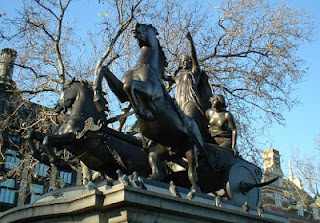
Boadicea and her daughters opposite Big Ben
Aside from a short-period following an uprising led by Boadicea in 60AD that temporarily chased the Romans from Londinium and earned a first rate placement for her stone-likeness across from Big Ben, Britania was Roman for five centuries. Abandoned in the early 5th Century, central Londinium likely, remarkably, sat empty for 400 to 500 years, the result of the plague as much as the decline of the Roman Empire.

Another head scratcher for those of us who think of England as a colonizer and empire builder, it was the Angles, a Germanic tride from which the word England descends, that sailed from the northern most State in Germany, Schleswig-Holstein, and settled during the 5th and 6th centuries. England first became a unified state in 927 AD, a millennia after Ceasar landed.

The realization for me in all of this: London is not an ancient city like Rome (7th Century BC) or Jerusalum (4 Millennia BC). It began simply as a Colony of another Empire from another era as humans gradually spread the globe from Mesopotmia origins.

A William reference near Leadenhall Market in London
Founded by Romans, and more permanently settled by Germanic tribes, it was William the Conqueror, a Norman King hailing from Normandy, France who got the French into the mix by landing in 1066 near the old Londinium site and begining construction of a fortification known today as the Tower of London and home to the Queen's Crown Jewels. A few years later, seeking to secure the Western approach to London, William designs and begins construction of Windsor Castle 20km upstream. Given Windsor Castle is the oldest in active service, where Queen Elizabeth spends most of her weekends, it could be said William the Conqueror and his posse from across the Channel didn't do a half bad job. Perhaps that further explains why most English refer to William not as "the Conqueror" but alternatively, "the Bastard." A Frenchman founding key assets of the Crown? That explains a lot.
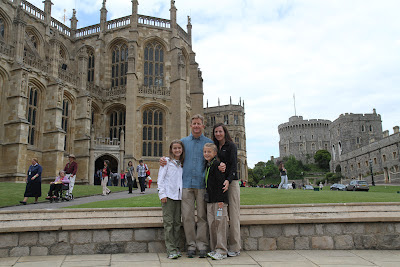
At Windsor Castle, St George Cathedral left, the Center
Keep in the back right

Gradually the tables turned and the English started doing the conquering, frequently going North into Scotland and South into France. In fact, the next thousand years saw the English Channel act as a net dividing two halves of a giant ping-pong table across which Generals and Monarchs served and volleyed attacks as a means to cement their glory (whenever they weren’t at war within their own boundaries). For English Monarchs "invade France" served the same, always popular, political purpose as "cut taxes" does for politicians today.
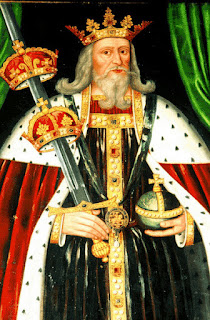
Edward III with the Crowns of
Scotland and France

Edward III, in his portrait hanging in St George Cathedral on the grounds of Windsor Castle, is painted with two crowns run through on his Sword – one for Scotland, one for France. Fresh off conquests in France, he established the Order of the Garter in 1348. Modeled after King Arthur’s Knights of the Round Table, the group had 25 founding members and exists to this day with St George’s Cathedral serving as its home.

Henry VIII, immediately after coming to power invaded France at Calais, a small beachhead from which he laid claim to the greater France. Classic politics – take an inch and claim a mile.

From the French end, why wouldn’t Napoleon, seeking to consolidate his position following the political void opened by French Revolutionaries beheading of Louis XVI, do in the early 19th Century what everyone else had done previously and invade his neighbors to the North?

General Nelson’s victory at Trafalgar and Napoleon’s ultimate demise at Waterloo kept stoneworkers very busy carving English military leaders for placement in St. Paul’s Cathedral forever immortalized as heroes of the State. There are more military and monarchial figures in St Paul’s than religious figures. Though the battle cost Nelson his life, he got his own stone likeness and column with a view placed forever at the center of Trafalgar Square. Yeah, the English disliked Napolean that much.

On Guard at Windsor Castle
Over a century later, the Nazi’s fully intended to take a crack at it by sending troops across the Channel after softening the English up with their bombs. Did Hitler know the Angles Story and presume England was rightfully German? Beats me, but I do know that by D-Day 1944, landing an army across the Channel was hardly a new idea.

Ghost chasers, we zigzag our way across Londinium on double-deck buses, the Underground, boats, and trains, but mostly on foot, gradually assembling the many layers of Londinium, a four dimensional puzzle of pieces forged across two millennia. 

The finger prints of people who took a turn shaping London's second millennia are everywhere. We run into William the Bastard, Edward III, many faces of the Tudor dynasty like Henry VII and VIII and Elizabeth I. We meet the King George(s) of the “American Uprising” era, Queen Victoria, Queen Mary, and many more.

Edward III’s finger prints are most present in the trappings of the aforementioned Order of the Garter established in 1348. Prince Charles claims his membership as one of the greatest honors bestowed upon him. In Windsor Castle, St. George’s Hall is a massive dining room in which all members of the order since its founding are named on the walls along with their Coat of Arms. Their positions are also marked in the choir of seats at St George’s Cathedral. The Order – its customs, traditions, prestigious membership, and annual Trouping of the Color ceremony that will take place today make Edward impossible to forget.

Henry VIII by Hans Holbein
We see the fingerprints of Henry VIII the most. He is embroidered into the tapestries of the Cathedral in Bayeux, France. His armor is prominently displayed at the Tower of London along with recognition of his additions made to the fortifications he retreated into on occasion. The portait of him at about age 40, by which he is infamously known, hangs in the semi-private living apartments at Windsor Castle, one of the more than 60 homes and palaces he owned as Monarch. Of course, his fingerprints are all over Hampton Court Palace, effectively, his man cave. Henry VIII is buried along with his favorite wife, Katherine Seymour, in St George Cathedral at Windsor Castle.
Inside the Globe Theater
The finger prints of Queen Elizabeth I and the Elizabeathan age are most visible at the Globe Theater, a recreation of it anyway. Located 300 meters from the original site of the Globe adjacent the Thames and Millennium Bridge, it is a remarkable homage to the works of William Shakespeare.  A giant doughnut when viewed from above, the center is a courtyard in which up to a 1,000 people would stand for a “stinky penny” to see the show. Today, they let 700 people in for 5 pounds each, still a bargain for a Shakespeare production. Back in the day, those who didn’t smell quite as bad could pay three pennies for one of the 3,000 seats under the thatch roof covering the theaters circular perimeter. Today, the three tiers of bench seating surround the stage on ¾ of the perimeter putting 1,500 people right on top of the stage. From the third level you literally look down with a bird's eye view. The stage occupies the other ¼ of the perimeter and juts into the courtyard. With no microphones, stage lighting, or any other modern accoutrements, the Globe is designed to be as true to the original as possible less the stink of seldom bathed Elizabethans.

Unofficially, our tour guide conquers, the 37 works of William Shakespeare had to have been the product of a team of writers and actors collaborating under the same pen name. That is not to say William Shakespeare was not an individual, he was, but rather the extent of the body of work and insight that went into creating it would have required the perspectives of actors as well as writers to make it work so well. Notably, Shakespeare’s wife and daughter were not able to write. He never attended University. He left behind no books or works in his Will; anecdotal evidence at best, but interesting.
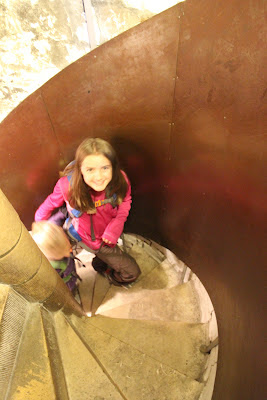
Ascending the Medieval stone stairs
inside Bloody Tower
Elizabeth I finger prints are also prominent at the Tower of London, specifically at Bloody Tower which often served as a prison ward. She twice “Sent to the Tower” Sir Walter Raleigh, perhaps the most famous prisoner before ending up there herself. Originally imprisoned for marrying a member of Elizabeth’s Court without her permission, Raleigh resided comfortably there with his wife, two sons and three servants between quests to find Dorado, the City of Gold, rumored to exist in the New World.

Notably, it was Elizabeth I who restored the authority of the Pope and Rome's influence in England, reversing the act of her father, Henry VIII, who consolidated Church and State under his rule in order to facilitate the granting of his divorce from Katherine of Aragon. The daughter of Anne Boleyn, Henry VIII's second wife, it is ironic that the Pope would later declare Elizabeth as illegitimate off-spring and encourage her subjects not to follow her.  It is further ironic, that Henry VIII’s most effective prodigy as Monarch would turn out to be his youngest daughter. Did I mention he had her mother beheaded such that he could move onto wife number 3 of 6?

Visitor entrance to Windsor Castle
Queen Mary II (of William and Mary fame) is most visible in the Baroque architectural style adopted for the expansion of Hampton Court Palace and similarly applied at Windsor Castle. It stands in stark contrast to the Tudor architecture of Henry VIII and the medieval kings that preceded him.

The ghost of Queen Victoria is visible around many sites; her finger prints mainly in what her taste, style, and strict moral virtue came to define as the Victorian Age. Ascending to the throne at age 18, her reign was the first to see a 60th Jubilee. Her 9 children and many of her grand children married into royal families across the continent garnering her the knickname "the Grand Mother of Europe" and cementing the role and influence of the modern day Monarchy.

The ghost of the later Queen Mary (known as Mary of Teck from German descent and married to Victoria's Grandson George V) is most visible in the form of a doll house constructed in honor of her Birthday. On display in the Apartments of Windsor Castle, 150 different artists contributed to the work. It is a 1:12 scale model with nearly a hundred rooms that are fully functional, in that they have electric lighting, running hot and cold water, working lifts, a wine cellar, replicas of famous oil paintings, furniture, the works.
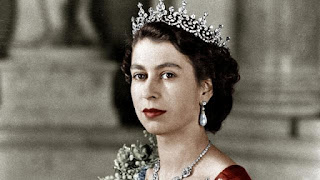
Queen Elizabeth II, circa 1953
The reigning Queen Elizabeth II, her 60th Anniversary Jubilee occurring the week before our arrival, is truly everywhere. Physically she resides at Buckingham Palace with weekends spent at Windsor Castle. Her jewels, The Crown Jewels, sit at the Tower of London. Her image is on the Pound, in shop windows, souvenirs, newspapers, and all over television. A gallery of sixty images taken over sixty years sits in Windsor Castle near the Queen’s Ballroom. She is featured variously with John F and Jacqueline Kennedy, Diana, Ronald Reagan, Margaret Thatcher, soldiers and leaders from around the globe, and even Lady Gaga. Pictures of her with infant son Prince Charles and later her infant Grand Children compliment those of that family grown, married, and ready to succeed her.
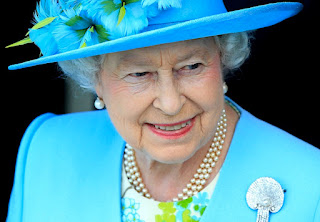
Queen Elizabeth, 2012
Laura marvels at the wear and tear we see on American presidents after four to eight years in office. The before and after pictures are dramatic of the effect the stresses and schedules of that office have on a person.

“How does a person handle that with such grace over a period of sixty years and look so remarkable at 86 years old?” Laura marvels. Albeit more focused on humanitarian efforts and matters of national pride, than military conquests, the Queen’s tenure and impact is nevertheless remarkable. Who else around the globe has met with both JFK and Lady Gaga?

“We call the US a melting pot,” Laura comments at Lunch as tables around us yammer on in multiple different languages, “but it is nothing compared to London.”

She is right. Whether the result of colonial roots, conquest, occupation, immigration, or its own colonization efforts, the influence of two millennia of ghosts is evident in the multiple cultures and languages always around you. There isn’t a street we have walked where English is the only language in your ears. Londinium is the most international of cities we have visited. Laura nailed it.

It is only fitting this Summer London will become the only City to host the Olympic Games three times (1908, 1948, and 2012). Modern day Persians, Greeks, Italians, French, Germans, members of former colonies, they will all be back; fortunately with athletes, not soldiers.

P.S. Special thanks to Jimmy Wales and the Wikipedia community who helped me understand what we were looking at half the time! Stone inscriptions tend to be rather brief. It would be great to see Wikitags on all the points of interest that you could grab from your mobile phone.; talk about the ultimate waking tour guide.

Ghost Chasing by Boat

Tuesday, June 12, 2012

Chelsea FC

Tuesday, 12 June 2012


A visit to Stamford Bridge, home of the reigning European Club Champion Chelsea FC, is a bit like visiting Wrigly Field or Fenway Park in the States. Opened in 1877, "the Bridge" has the same authentic feel and eccentricities of a place that is as much Museum as Stadium.

Located in the burroughs of Chelsea and Kennsington, part of the 32 burroughs that make up London, Stamford Bridge is the closest Premier League stadium to the heart of London at about 20 minutes. At a capacity of 42,000 people, the venue is intimate, yet the 7th largest English Premier League venue. It reminds me of running at Hayward Field in Eugene, OR - the best Track and Field venue in the USA though far from the largest.

The reach and fan base of the club is so great Samsung pays 80 million Pounds to put their logo on the front of the teams Jersey. Adidas pays 100 million pounds to provide jerseys to the team and the millions of fans who shell out big bucks every year for a replica. The two story gift shop is bigger than the museum that tells the 107 year history of the Club if that gives you any indication.

We sat for a photo at the interview table in the pressroom we see so often on the Fox Soccer Channel. From this spot, live shots of coaches and players doing interviews are beamed around the world. Our tour group includes people from India, Dubai, Egypt, Denmark, San Francisco (and Colorado), as well as from around the UK. The English Premier League and Chelsea FC truly draw a global fan base. The Egyptians ask questions about who will replace their Stryker, Didier Drogba from France, who won't return after seven years with the Club. Regardless of where they reside, these fans of the club in Blue know their team.

The "Losers" dressing room, as they call it, is tiny compared to the home teams dressing room, even after being recently remodeled and enlarged. The new mirror in the visitors dressing room was put in "specifically for Cristiano Ronaldo to admire himself" quips the Chelsea staffer leading our tour.

The players, of course, are all back with their National teams, most  playing in the European Championships being contested in Poland and the Ukraine right now.  Even so, the joy of Chelsea winning their first European Champions League title and the FA Cup this year is quite fresh on everyone at Stamford Bridge. The Cup is in the museum and for 30 pounds you can get three picutre of yourself with it. The Clubs name and year of victory is engraved on the trophy and, like the Stanley Cup in Hockey, travels year-after-year with the reigning champion. Faster than you can say "tourist," we shell out 30 Quid and get the shots along with making a donation on gift shop souveniers.

Joelle is beside herself when we see a mural of Petr Cech, the Chelsea Keeper she likes to mimic when playing between the pipes herself. Better known for the padded helment he wears than saving more shootout PKs than his Bayern Munich opposite to decide the Champions League Champion, Cech is nothing short of a colorful character.

Given a choice we would spend the day with the club from Barcelona but when in London, hanging out with the boys in Blue at Stamford Bridge is a great call. It is awesome to get to know a classic Premier League team up close. It doesn't quench our thrist however. In fact, it makes it worse as now we want to come back for a match!